
Effect of liquid smoke and flower inducer (TDZ+BA) concentration on flowering of Robusta coffee (Coffea canephora)
Article Sidebar
-
Cytokinins, Flowering, Liquid Smoke, Robusta Coffee, TDZ
Abstract
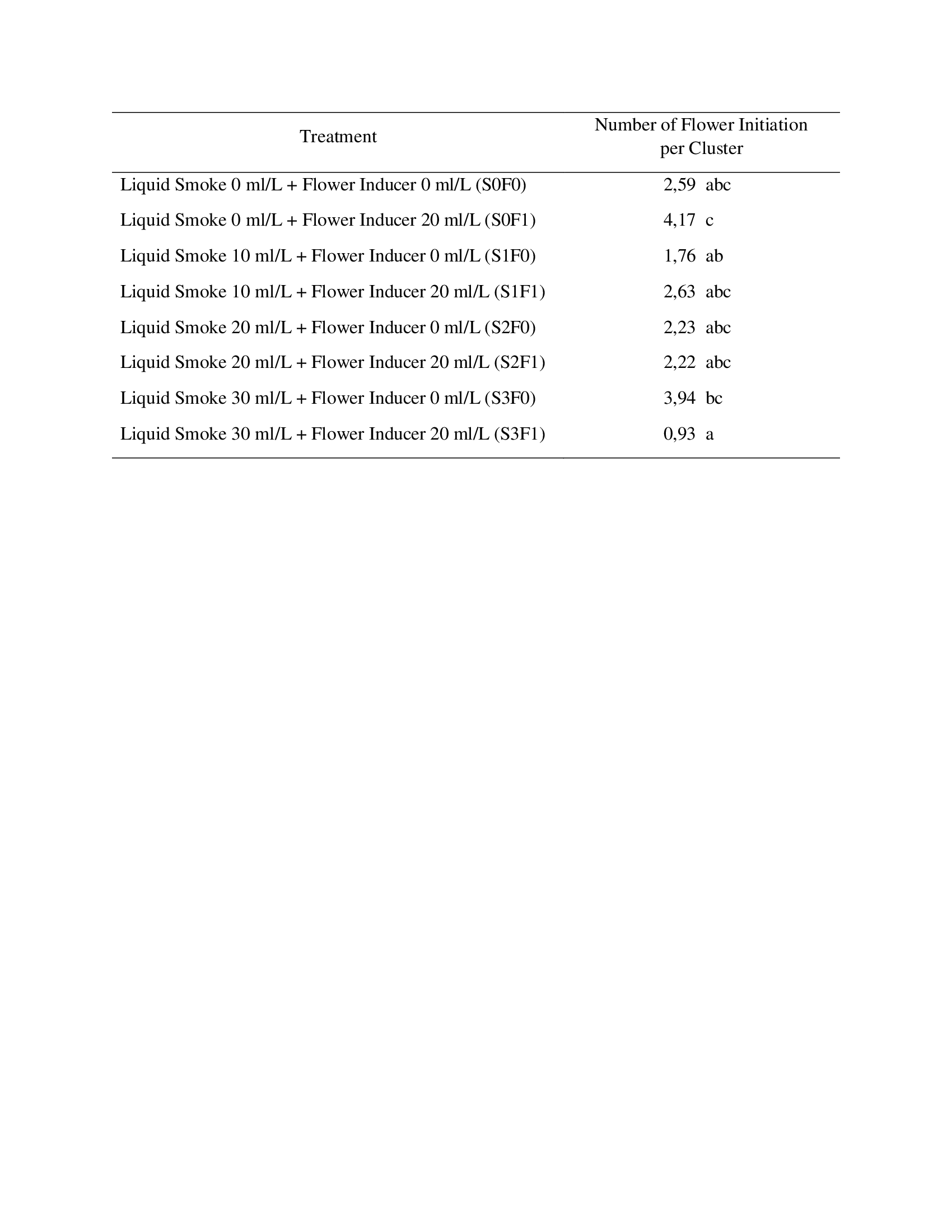
Coffee yield could be increased in several ways, one of which is through inducing flower. The provision of liquid smoke and flower inducer can stimulate flowering of coffee trees. This research aims to determine the effect of liquid smoke and flower inducer concentrations and their interactions on coffee flowering. This research was conducted at the Agronomy Laboratory, Faculty of Agriculture, University of Lampung and in research plot of Sidomulyo Village, Air Naningan District, Tanggamus Regency from August 2024 to January 2025. This research employed a factorial Randomized Complete Block Design (RCBD) (4x3) with 3 replicators. The first factor is liquid smoke with a concentration of 0 ml/L (S0), 10 ml/L (S1), 20 ml/L (S2), and 30 ml/L (S3). The second factor is flower inducer (F) with a concentration of 0 ml/L (F0) and 20 ml/L (F1). Homogeneity of variance between treatments was tested using the Barlett Test to determine the homogeneity of variance between treatments, data additivity was tested using the Tukey Test, then the data was analyzed using analysis of variance and standard error of mean. The difference in the mean value of the treatment was tested using the Duncan Test at the 5% level. The results showed that liquid smoke treatment affected number of new branches (B0), number of flower initiation branches, number of flower initiation clusters per branch, and number of young fruits per cluster. Flower inducer treatment affected number of the first flowering branches (B1), number of flower initiation branches, and number of flower initiation clusters per b
Full text article
Authors
Authors retain copyright and grant the Journal of Smart Agriculture and Environmental Technology (JOSAET) the right of first publication. Articles published in JOSAET are licensed under the Creative Commons Attribution 4.0 International License (CC BY 4.0), which permits use, sharing, adaptation, distribution, and reproduction in any medium or format, provided that appropriate credit is given to the original author(s) and the source, a link to the license is provided, and any changes made are indicated.