
Growth and Yield of Corn (Zea mays L.) and Sorghum (Sorghum bicolor L.) Cultivated at Different Spacing in-Row Intercropping System with Rubber Crops (Hevea brasiliensis Muell. Arg.)
Article Sidebar
-
Intercrops, Light intensity, Shade
Abstract
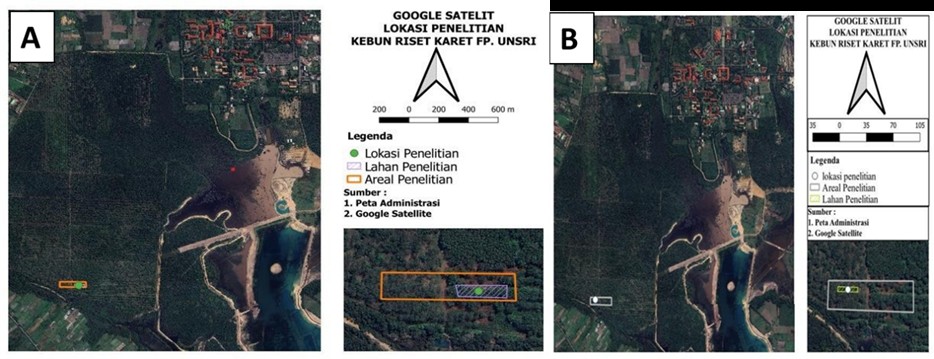
The efforts to increase productivity of rubber plantations can be carried out through polyculture planting patterns rubber of corn and sorghum. The aim of this research is to determine the rubber response and the growth of corn and sorghum intercrops with modified planting spacing. The research was conducted at the Rubber Research Facility, Faculty of Agriculture (3◦14′2′′S 104◦38′12′′E), Universitas Sriwijaya, Indralaya, Ogan Ilir, South Sumatera. The research was conducted in two experimental units using a randomized block design with four replications. Planting spacing was as treatment. There were three plant spacings for corn, the treatment spacing, which consists of three levels, namely 75 cm × 25 cm (JT-J1), 75 cm × 30 cm (JT-J2) and 75 cm × 35 cm (JT-J3). Meanwhile, the spacing for sorghum were as follows 75 cm × 25 cm (JT-S1), 75 cm × 50 cm (JT-S2), 75 cm × 75 cm (JT-S3). The results of research on polyculture of rubber plants with plant spacing treatment had a positive effect on corn and sorghum crops. The growth and production of corn crops is significantly increased with a planting spacing of 75 × 35 cm for corn and 75 × 75 cm for sorghum was the optimal planting distance, as reflected in the growth of stem circumference, leaf greenness, stalk weight, and weight of 100 grains.
Full text article
Authors
Authors retain copyright and grant the Journal of Smart Agriculture and Environmental Technology (JOSAET) the right of first publication. Articles published in JOSAET are licensed under the Creative Commons Attribution 4.0 International License (CC BY 4.0), which permits use, sharing, adaptation, distribution, and reproduction in any medium or format, provided that appropriate credit is given to the original author(s) and the source, a link to the license is provided, and any changes made are indicated.