
Rehabilitation of the Ecological and Economic Functions of Urban Coastal Areas: A Mixed-Methods Assessment of Urban Aquaculture in Ketapang, Tangerang Regency, Indonesia
Article Sidebar
Abstract
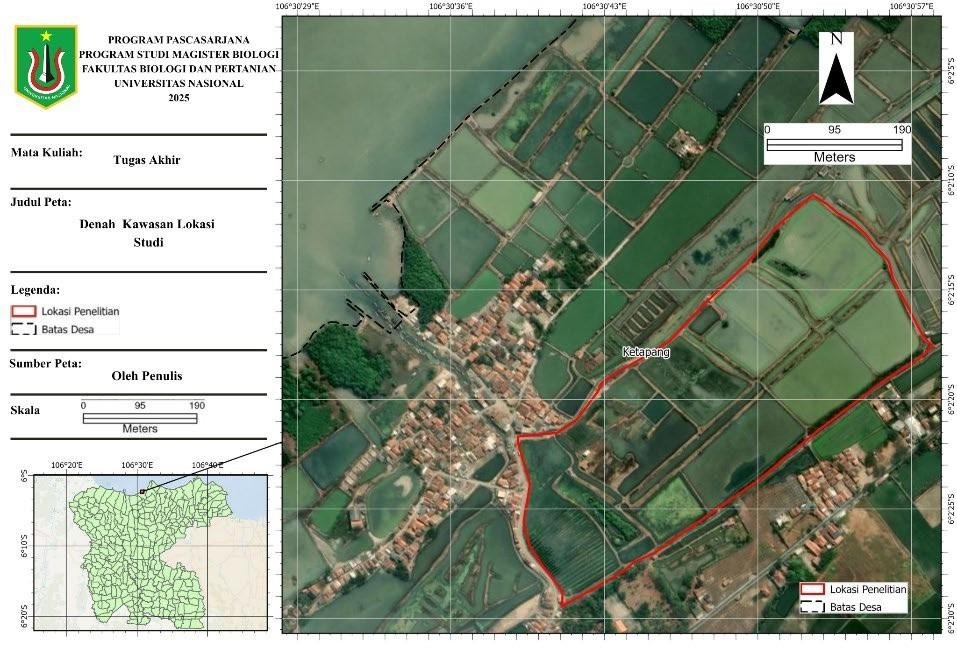
Mangrove-based ecotourism integrated with urban aquaculture has emerged as a promising strategy linking conservation with livelihood improvement in Indonesia’s rapidly urbanizing coastal zones. However, empirical assessments that simultaneously address ecological, socio-economic, and governance dimensions remain limited. This study evaluates the Ketapang Urban Aquaculture (KUA) mangrove ecotourism site (14.5 ha) in Tangerang Regency, Banten Province, using a sequential exploratory mixed- method design that combines Sentinel-2 satellite imagery analysis with structured surveys (n = 9), semi-structured interviews with key informants, and field observations conducted between May 2025 and January 2026. Mangrove Vegetation Index (MVI) time-series analysis via Google Earth Engine revealed a 1639% increase in mangrove cover from 0.551 ha (2020) to 9.583 ha (2025), with a compound annual growth rate of approximately 77 to 78%. Despite this substantial areal expansion, the mangrove health index remains at a moderate level. Socio-economic findings indicate low and declining visitor numbers (5 to 10 on weekdays; 10 to 20 on weekends), closure of approximately 20 food stalls, and non-operational status of four formerly supported micro, small, and medium enterprise (MSME) groups. Community participation is largely confined to operational activities, with limited involvement in planning and decision-making. A welfare gap exists between internal management staff, who report relatively stable income, and vendors/MSME actors, whose livelihoods are directly affected by visitor decline. Annual operational costs (IDR 300 to 500 million) exceed tourism revenue, raising concerns about financial sustainability. The findings suggest that KUA has achieved notable ecological rehabilitation success but has not yet translated this into broad-based socio-economic benefits. Strengthening community-based governance, diversifying revenue streams, improving visitor infrastructure and digital promotion, and formalizing benefit-sharing mechanisms are recommended to advance the site toward a more sustainable and equitable ecotourism model.
Full text article
Authors
Authors retain copyright and grant the Journal of Smart Agriculture and Environmental Technology (JOSAET) the right of first publication. Articles published in JOSAET are licensed under the Creative Commons Attribution 4.0 International License (CC BY 4.0), which permits use, sharing, adaptation, distribution, and reproduction in any medium or format, provided that appropriate credit is given to the original author(s) and the source, a link to the license is provided, and any changes made are indicated.